LLMs.txt Group: Pages

This section contains the website’s standard pages.

  • Parking Lot Storm Sewer & Manhole Replacement

    Parking Lot Storm Sewer & Manhole Replacement

    HT Strenger repairs and replaces storm sewer structures under commercial parking lots and drives across Lake County and greater Chicagoland. Property managers, HOA boards, retail landlords, industrial park owners, and municipalities call us when a catch basin has collapsed under a truck axle, a manhole cover is sitting three inches below grade, or a storm main has failed and the lot floods every heavy rain. We handle the excavation, the structure replacement, the pipe repair, and the asphalt or concrete patch, and we pull the permits your village requires.

    We inspect the structure with the lid off, sound the pipe with a camera when the geometry allows, and give you a straight recommendation on repair versus replacement.

    IL Plumbing License #055-013973. Family-owned since 1911.

    Why Storm Structures Fail

    Parking lot storm sewers take a beating that homeowners never see. The common failure patterns:

    Settlement around the structure. The pavement drops, the frame stays put, and now the lid sits proud of the surface and cracks the surrounding asphalt.

    Frost heave and freeze-thaw cracking. Northern Illinois winters cycle above and below freezing dozens of times a season. Old brick catch basins and even mid-century precast structures crack, shift, and leak.

    Truck axle loads. A catch basin frame that was fine for a 1980s-era Ford Econoline gives out under modern delivery trucks and fire apparatus.

    Root intrusion. Storm laterals are almost never as tight as the plans suggest. Roots find the joints, then take over.

    Sediment and grit buildup. Sump basins that were never cleaned fill with silt and stop catching water at the surface.

    Manhole and Catch Basin Replacement

    Full replacement usually means excavating the failed structure, cutting back to sound pipe, setting a new precast manhole or catch basin, resetting the frame and lid to the finished grade, backfilling with compacted stone, and restoring the surface. On busy commercial lots, we phase the work so the property stays open, and we barricade the excavation to the village’s traffic-control requirements. Where feasible we use rehab methods like manhole lining and grade adjustment rings instead of full replacement, and that saves the owner meaningful money on structures that are still fundamentally sound.

    Storm Main and Lateral Repair

    When the pipe itself is the problem, we camera the run, cut back to sound pipe, replace the damaged section, and restore the trench. On longer runs we can trenchless-line the pipe from an existing structure and avoid tearing up more of your lot than necessary. Where the storm system ties into the village combined sewer, we coordinate with the local public works department for the tap and inspection.

    Talk to Us About Your Lot

    We can walk your property, quote the repair or replacement, and schedule the work around your tenants’ hours. Call 847-234-9440 or use our contact form to reach a licensed commercial plumber.
  • Commercial Water Booster Pump Systems

    Commercial Water Booster Pump Installation & Service

    HT Strenger designs, installs, and services commercial water booster pump systems for multi-story office buildings, apartment complexes, hotels, medical buildings, warehouses, and manufacturing facilities across Lake County and greater Chicagoland. When incoming municipal water pressure will not reliably serve every fixture in your building, a properly sized booster package solves the problem quietly, efficiently, and to code.

    If tenants are complaining about weak showers on the top floor or if your fire pump is being asked to bail out domestic pressure, it is time to look at a booster.

    IL Plumbing License #055-013973. Family-owned since 1911.

    When You Need a Booster

    The village mains deliver whatever pressure they deliver. On a good day in most of Lake County that is 45 to 65 PSI at the meter. That is fine for a one-story storefront. It is not fine for:

    • Three-story or taller buildings where the top floors get 20 PSI or less at the fixture.
    • Buildings at the end of a long service line or on the high side of a pressure zone.
    • Apartment or hotel occupancies where morning peak demand collapses the pressure across the whole building.
    • Any facility that added floors, added tenants, or added irrigation without upsizing the incoming service.
    • Buildings that rely on a well and cannot get consistent pressure from the well tank alone.

    Variable Frequency Drive (VFD) Packages

    The current standard for commercial boosters is a duplex or triplex constant-pressure package with variable frequency drives on each pump. VFDs ramp the motors up and down to hold a set pressure regardless of demand, instead of banging on and off like the old constant-speed hydro-pneumatic setups. That means less noise, less energy waste, longer motor life, and no big pressure swings when a fixture opens across the building. We install and service the major commercial brands, including Grundfos, Bell & Gossett, Armstrong, and Xylem Goulds.

    Sizing, Redundancy, and Code

    Booster sizing is a real engineering exercise. Peak fixture load, minimum incoming pressure, target discharge pressure, and required flow all drive the pump selection and the number of pumps in the package. We size to your actual building, not to a stock catalog cut. For occupied residential and hospitality buildings we recommend duplex or triplex packages so a single pump failure never leaves tenants without water.

    Service, Repair, and Retrofits

    We service existing booster packages too. Common calls include leaking mechanical seals, failed pressure transducers, VFD faults, expansion tank replacement, and control panel programming. Where an older constant-speed hydro-pneumatic booster is nearing end of life, we retrofit to a modern VFD package on the same footprint and cut the operating cost noticeably.

    Talk to Us About Your Building

    Call 847-234-9440 or use our contact form to schedule a booster consult, a service call, or a replacement quote.

  • Grease Trap Replacement & Service

    Grease Trap Replacement, Service, and Compliance

    HT Strenger installs, replaces, and services commercial grease interceptors across Lake County and greater Chicagoland. Restaurants, cafeterias, bakeries, hotels, and any kitchen that runs a three-compartment sink or a wok line is required by the local sanitary district to keep fats, oils, and grease out of the public sewer. When your trap is undersized, cracked, or past its rebuild life, we scope the replacement, pull the plumbing permit, coordinate the pump-out, and install the new unit.

    We start with an on-site inspection and a review of your last two years of pump-out tickets. If the tank still has service life, we say so.

    IL Plumbing License #055-013973. Family-owned since 1911.

    When a Grease Trap Needs to Be Replaced

    Not every grease problem is a replacement. Sometimes it is a pump-out schedule that fell behind, or a partition baffle that needs to be reset. Real replacement candidates usually show one of these:

    • Rusted-through steel tanks in older restaurants (typical 15 to 25 year service life).
    • Cracked concrete or fiberglass tanks that are leaching odors or letting groundwater in.
    • Traps that are undersized for the current kitchen. A grease interceptor sized for a 30-seat cafe will not keep up with the same footprint after it becomes a 90-seat family restaurant.
    • Traps installed on the wrong side of a modernized dish machine or garbage disposal.
    • Chronic grease discharge violations from the sanitary district despite a normal pump-out schedule.

    Sizing and Local Code

    Grease interceptor sizing is not guesswork. The Illinois Plumbing Code and most Lake County sanitary districts specify sizing based on drainage fixture units, sink volume, or gallons-per-minute flow through the connected fixtures. Under-sizing gets you a compliance letter within a year. Over-sizing costs you thousands of extra dollars and complicates the pump-out. We size to code and to your real operation, not to whatever tank the supply house had on the shelf.

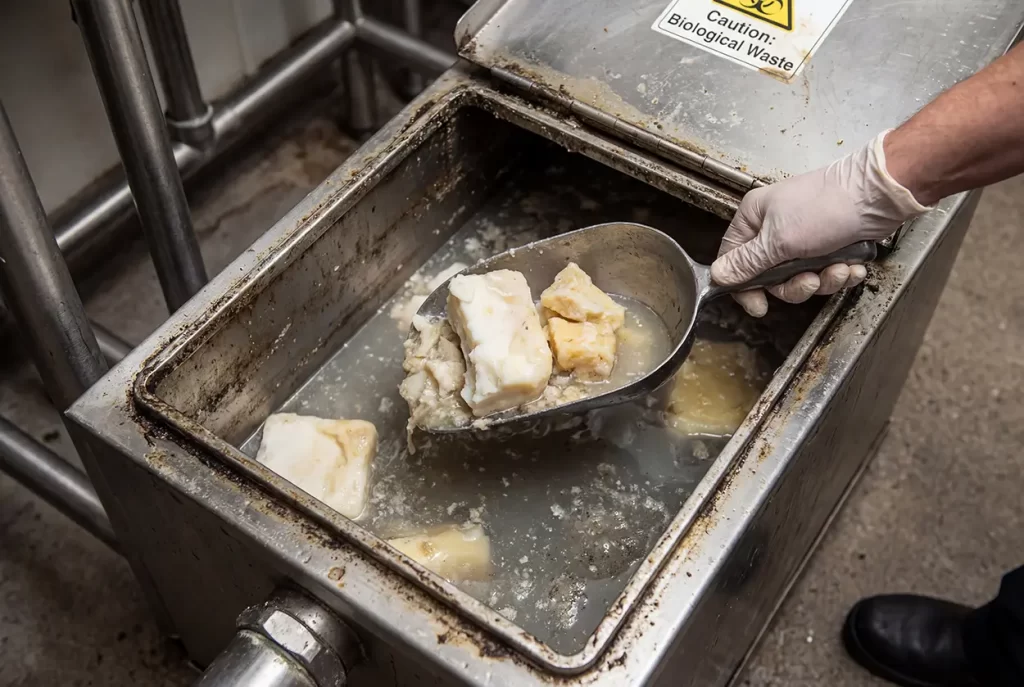
    grease trap cleanout

    Indoor Hydromechanical vs. Outdoor Gravity Interceptors

    Smaller kitchens usually run a hydromechanical grease interceptor under the three-compartment sink, sized in gallons per minute (typical 20, 35, or 50 GPM units). Larger operations run an outdoor in-ground gravity interceptor sized in total capacity (1,000 to 2,000 gallons is common). Each has its trade-offs on cost, pump-out frequency, and available space. We help you choose the right style for your kitchen, then handle the permit and install.

    Service, Repair, and Pump-Out Coordination

    Between replacements, we service what you have. That includes baffle repair, flow-control fitting service, lid and gasket replacement, high-pressure jetting of the inlet and outlet branches, and coordinating pump-outs with a licensed hauler on the cadence your district requires. We keep a service record so your health inspector or sanitary district inspector always has documentation ready.

    Talk to Us About Your Kitchen

    Whether you are opening a new location, dealing with a compliance letter, or planning ahead on a tank that is nearing end of life, HT Strenger can scope the work. Call 847-234-9440 or use our contact form to reach a licensed commercial plumber.

  • Flushometer Toilet Installation & Repair

    Flushometer Toilet Installation, Repair, and Retrofit

    HT Strenger services the flushometer toilets and urinals that run in schools, hospitals, office buildings, restaurants, retail stores, and municipal facilities across Lake County and Chicagoland. If your restroom uses the exposed chrome valve above the bowl instead of a tank, you have a flushometer. When they work, they last for decades. When they fail, they flood a stall, run continuously, or refuse to flush at all. We rebuild the ones worth rebuilding, replace the ones that are past it, and retrofit older units to modern low-flow standards. IL Plumbing License #055-013973.

    Common Failures We Fix

    • Constant trickle or full-on running (usually a worn diaphragm kit, sometimes a stuck relief valve).
    • Weak or short flush that does not clear the bowl (often a debris-clogged control stop or a dying diaphragm).
    • No flush at all (broken handle assembly, closed control stop, or blown vacuum breaker).
    • Water hammer or a loud “clunk” at the end of the flush (worn parts, or the wrong flush volume for the fixture).
    • Sensor-operated units that flush on their own or ignore the user (dirty sensor, dying battery, or bad solenoid).

    Most of these are 30-minute fixes with the right rebuild kit on the truck. We stock parts for the major manufacturers (Sloan, Zurn, Delany, Toto, and American Standard) so we are not guessing on the second visit.

    Manual, Sensor, and Retrofit Options

    Sensor-operated flushometers are the standard install now in high-traffic public restrooms because they reduce touch points and cut water waste from users who walk away without flushing. We install hardwired and battery-powered sensor units, and we retrofit manual valves to sensor operation without replacing the whole fixture. If your building is chasing a LEED or WaterSense credit, we can also drop flush volumes from older 3.5 gallon-per-flush units down to modern 1.28 or 1.6 GPF without replacing bowls that were designed for the higher volumes.

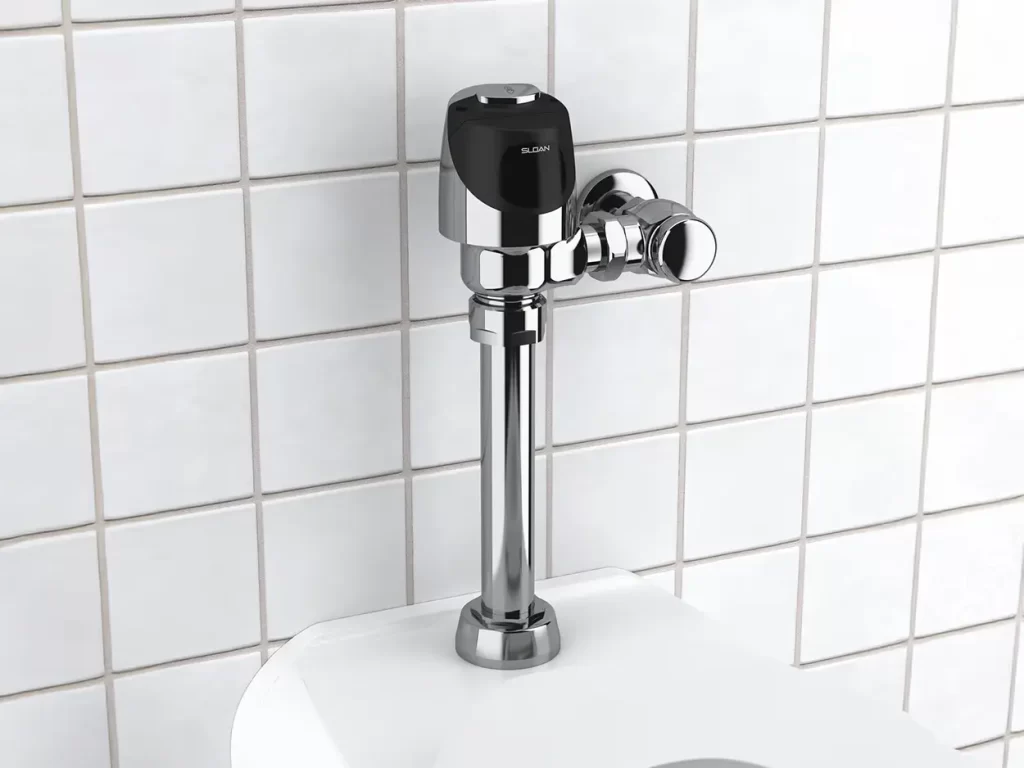
    Flushometer
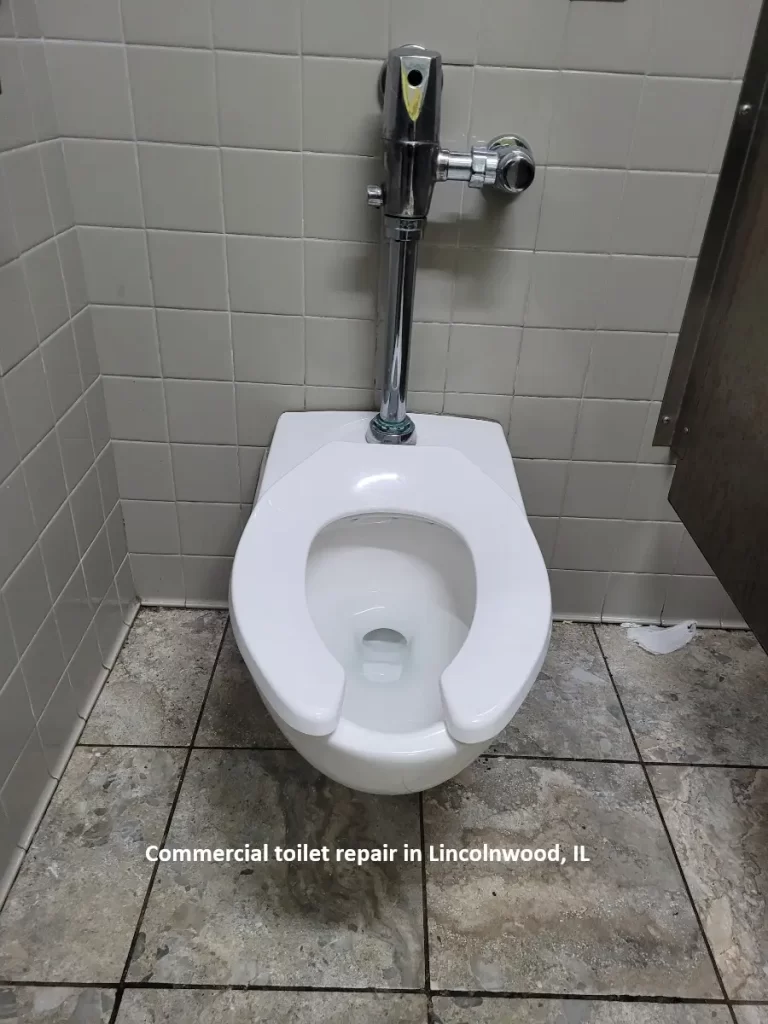
    Commercial Toilet

    ADA Compliance and Fixture-Height Issues

    Public restrooms in Illinois follow both the Illinois Accessibility Code and the ADA Standards for Accessible Design. When we replace flushometers in a school or office renovation, we double-check that the bowl height, side clearance, and control-side reach match current code. It is a common thing missed on cosmetic remodels, and it becomes a bigger problem at the next inspection than it needed to be.

    Talk to Us About Your Restrooms

    Whether you have one running valve at your storefront or a full building’s worth of aging fixtures, we can inspect, quote, and schedule the work around your operating hours. Call 847-234-9440 or use our contact form.


  • Commercial Water Heaters

    Commercial Water Heater Installation, Repair, and Sizing

    HT Strenger installs, services, and replaces commercial water heaters across Lake County and greater Chicagoland. Restaurants, hair and nail salons, gyms, laundromats, apartment buildings, medical and dental offices, schools, and light industrial buildings all have peak-demand hot water problems that a residential heater cannot solve. We size the equipment to your actual fixture load, install with code-compliant venting and combustion-air, and service the units already in your mechanical room. IL Plumbing License #055-013973. Family-owned since 1911.

    Sizing Is Not the Same Job as Residential

    A busy salon with four backwash bowls will drain a 40 or 50 gallon residential tank inside of an hour. Sizing a commercial water heater is a calculation, not a guess. We look at your fixture count, the flow rate at each fixture, your peak-hour draw, and your recovery requirement, then we choose storage capacity and BTU input that carry you through the busy period without cold-water complaints. Under-sizing hurts your operation. Over-sizing burns fuel and money for no benefit.

    Tank, Tankless, or a Bank

    • Storage tank heaters (typical 75, 100, or 120 gallon commercial gas units) are the default for most restaurants, offices, and multi-tenant buildings. Predictable, straightforward to service, easy to replace at end of life.
    • Tankless heaters work well for laundromats, salons, hotel rooms, and any operation with continuous flow demand and space constraints. They also cut standby losses that add up on 24-hour buildings.
    • Tank-plus-tankless hybrid and manifolded tankless banks handle high-flow kitchens, fitness centers, and buildings with unpredictable peaks. We wire multiple units into a common manifold with staged operation so you get storage-tank reliability and tankless-style recovery.

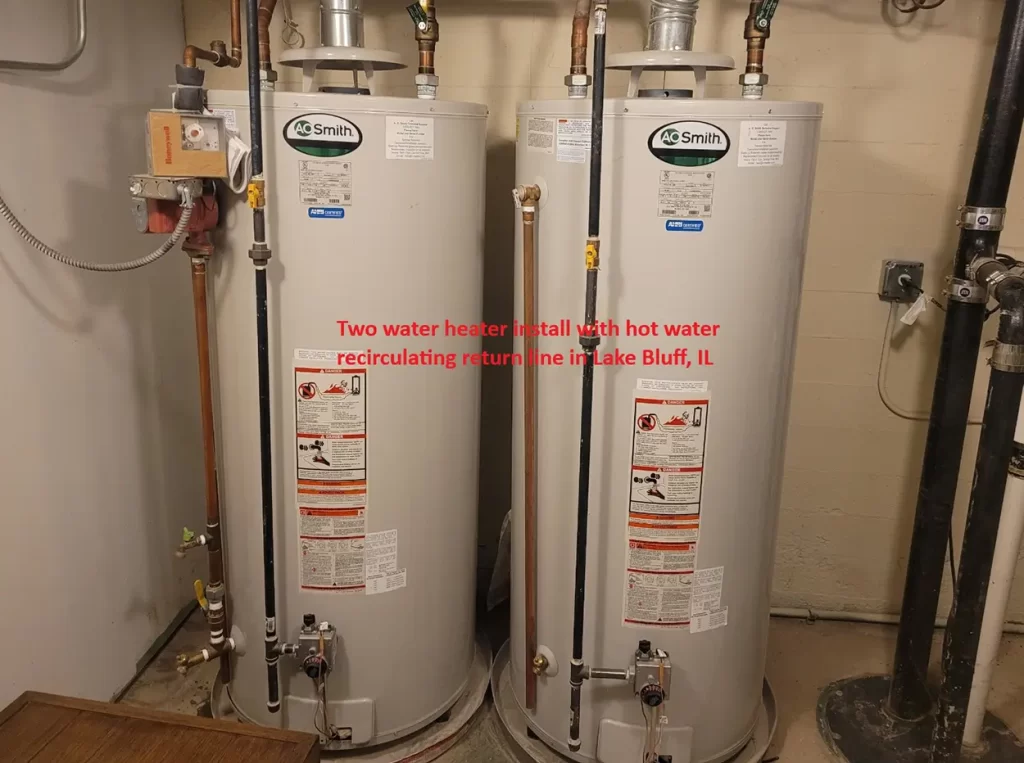
    We install and service the major commercial brands including A.O. Smith, Bradford White, Rheem, Lochinvar, Rinnai, and Navien.

    Two water heaters installed

    Venting, Combustion Air, and Code

    Commercial water heater installs in Illinois need to meet the Illinois Plumbing Code, the Illinois Mechanical Code, and any local village or fire district amendments. Category IV high-efficiency units need sealed combustion or a dedicated fresh-air intake. Power-vented units cannot share a chimney with an atmospheric appliance. Recirculation lines have to be sized so they do not thermosiphon backwards through the cold inlet. All of this is table-stakes for a licensed commercial plumber and none of it is worth having a handyman guess at.

    Maintenance and Repair on Existing Units

    We service what you already own: annual flush and inspect, anode rod replacement, T&P valve replacement, thermostat and gas valve repair, expansion tank service, and recirculation pump replacement. Lake County water is hard, so scale buildup shortens tank life faster than the manufacturer’s brochure implies. Regular service noticeably extends the years of dependable operation you get out of the same unit.

    Talk to Us About Your Building

    Call 847-234-9440 or use our contact form to schedule a sizing consult, a service call, or a replacement quote.


  • Commercial Pump Systems (Sewage Ejector, Grinder & Lift Stations)

    Commercial Sewage Ejector, Grinder Pumps, and Lift Stations

    HT Strenger installs and services the commercial pump systems that move sewage, wastewater, and stormwater out of below-grade fixtures and up to the gravity sewer. Basement bathrooms, below-grade break rooms, elevator sumps, floor drains in industrial buildings, and full lift stations serving buildings that sit below the sewer main all depend on these pumps to keep working, day and night. When they fail, they flood. We install new packages, service existing ones, and replace units that are past their service life.

    We install and service the major brands including Zoeller, Liberty, Little Giant, Myers, and Grundfos.

    IL Plumbing License #055-013973. Family-owned since 1911.

    Ejector Pumps, Grinder Pumps, and Lift Stations

    Different applications need different pumps.

    • Sewage ejector pumps handle solids up to 2 inches and are the standard for below-grade toilets, sinks, showers, and floor drains in a light commercial setting. Basin sizing typically ranges from 30 to 150 gallons depending on fixture load.
    • Grinder pumps shred solids before pumping, which lets them push through smaller-diameter force mains and much longer runs. They are the right call for buildings a long way from the gravity main, or where the discharge line runs uphill for hundreds of feet.
    • Effluent pumps handle graywater from below-grade sinks, HVAC condensate, and floor drains where there are no toilets on the branch.
    • Duplex and triplex lift stations put two or three pumps in one basin with alternating control so a single pump failure never floods the building. Municipal buildings, schools, and multi-tenant properties that cannot afford downtime should be on duplex at minimum.

    Duplex Redundancy, Alarms, and Battery Backup

    The single most common failure we see is a simplex pump that quit on a Saturday night in a building with no alarm. By Monday morning the janitor is standing in raw sewage. There is no reason to run below-grade sewage on an unalarmed simplex if the building carries any real occupancy. We recommend and install:

    • Duplex or triplex packages with automatic alternator control panels.
    • High-water float alarms wired to a building automation system or a dial-out notifier.
    • Sealed lead-acid battery backup on the alarm circuit so a power outage does not silence the alarm.
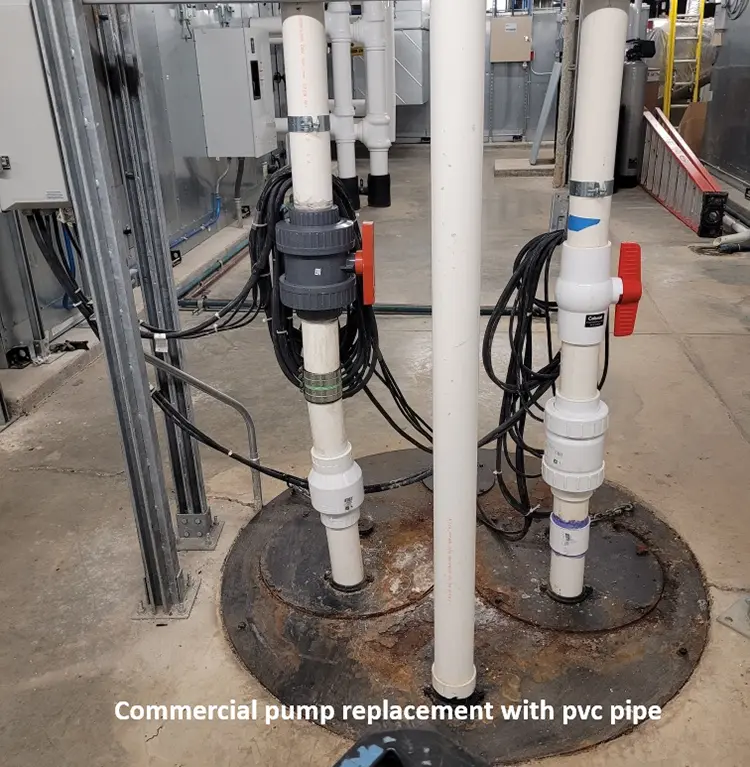
    Commercial Pump Replacement with pvp pip

    Service, Repair, and Emergency Response

    We service pumps we did not install. Typical calls include float switch replacement, check valve repair, control panel troubleshooting, seal replacement, and full pump swap-outs. For emergency backups and floods, our on-call crew responds across our Lake County service area.

    Talk to Us About Your Building

    Whether it is a basement break room, a below-grade tenant fit-out, or a full lift station, we can size the system, spec the redundancy, and quote the work. Call 847-234-9440 or use our contact form.


  • Loading Dock Drains, Trench Drains & Dock Pit Sumps

    Loading Dock Drain Installation, Repair, and Cleaning

    HT Strenger installs, repairs, and cleans the trench drains, dock pit drains, and dock sump pumps that keep loading docks working through Chicago-area winters. Warehouses, distribution centers, food service facilities, retail back-of-house docks, and manufacturing loading bays across Lake County rely on these systems to move snow-melt, rain runoff, and wash-down water away from the dock plate and out of the tenant space. When they clog or freeze, docks flood and freight sits.

    A dock that drained fine when the building was new is often at 30 percent capacity ten years in. We inspect, camera the run, and identify the actual restriction instead of guessing.

    IL Plumbing License #055-013973. Family-owned since 1911.

    Why Dock Drains Fail

    Loading dock drains are one of the toughest environments in the building.

    • Salt, sand, and grit ride in on trailer tires all winter and pack the drain body.
    • Snow and slush dumped off truck roofs and forklifts overwhelm undersized drains.
    • Sub-freezing air chills the pipe from the top down, and standing water in a trap freezes solid until spring.
    • Diesel, hydraulic fluid, and food-service wash-down leave residues that build up on drain walls and check valves.
    • Pallet drops and impact loading crack grates, warp frames, and shift trench sections out of alignment.

    Trench Drains, Point Drains, and Dock Pit Sumps

    Different dock configurations need different drainage.

    • Trench drains run parallel to the dock face and catch runoff across the whole approach. We install and repair pre-cast and cast-in-place trench systems with heavy-duty ductile iron grates rated for forklift and truck loads.
    • Point drains work in smaller docks and interior wash-down areas where a single low point does the job.
    • Dock pit sump pumps move water out of a dock leveler pit that sits below the surrounding grade. These are simplex or duplex packages with float switches and high-water alarms. They belong in every below-grade dock pit in a Chicago-winter climate.

    Cleaning, Jetting, and Repair

    Most dock drain problems are cleaning problems. We high-pressure jet the drain body, the trench, and the discharge lateral, camera the run to confirm the restriction is gone, and pull broken grates or repair heaving trench sections while we are there. When the drain body itself has failed (cracked concrete, rusted-through steel), we cut it out and replace with a modern polymer trench section rated for the truck loads.

    Talk to Us About Your Dock

    Call 847-234-9440 or use our contact form to schedule an inspection, a cleaning, or a full dock drain replacement.


  • Commercial Septic Field Maintenance & Repair

    Commercial Septic Field Maintenance and Repair

    HT Strenger maintains, repairs, and rebuilds commercial septic systems for businesses in the parts of Lake County and Chicagoland that sit outside municipal sewer service. Restaurants, banquet halls, campgrounds, small manufacturers, day care centers, veterinary clinics, storage facilities, and rural office parks depend on their on-site septic system to keep operating. When a field starts to fail, the business feels it before the health department does. We inspect, service, and rehabilitate commercial fields, and we replace the components that are past their service life.

    We start with a full inspection: tank levels and baffles, distribution box or drop box condition, field elevations, surface conditions, and pump history if it is a pressure-dosed system. Then we tell you what is actually happening.

    IL Plumbing License #055-013973. Family-owned since 1911.

    Why Commercial Fields Fail

    Commercial septic fields see loads a residential system was never designed to handle.

    • Higher daily flow than a household. A busy restaurant or day care can put 500 to 2,000 gallons per day through a system originally sized for 300.
    • Grease and detergents from kitchens and cleaning operations that suffocate the biological activity in the tank and the field.
    • Shock loads on weekends, banquets, and events that push flow well past the design rate for hours at a time.
    • Compaction over the field from parking, equipment storage, and delivery vehicles. Compacted soil cannot accept effluent, and a field that used to work fine develops surface breakout.
    • Age. Most on-site systems have a design life of 20 to 30 years. Older fields will eventually reach the end of their service life no matter how well they were maintained.

    Field Rehabilitation Before Replacement

    A full field replacement is a five-figure project. Before we quote it we look at what can be done to buy back capacity in the existing field:

    • Aggressive pump-out and inspection of the tank and grease interceptor.
    • Baffle repair and effluent filter installation if the tank is discharging solids to the field.
    • Drop-box rebalancing so no single lateral is doing all the work.
    • Field aeration or jetting where a biomat has choked off infiltration.
    • Adding a flow equalization tank or pressure-dose panel to smooth the peaks.

    Sometimes rehab buys another 10 years. Sometimes the field is done and we say so.

    When replacement is the right answer, we coordinate the soil evaluation, the design, the county health department permit, and the install with a licensed excavator. Lake County Health Department and the Illinois EPA both have rules for commercial on-site systems that are stricter than residential rules. We know the permit path. That saves weeks of back-and-forth.

    Talk to Us About Your System

    Whether you are dealing with a wet spot in the field, a compliance letter from the county, or a full system approaching end of life, call 847-234-9440 or use our contact form.


  • Roof Drain and Deck Drain Installation, Repair, and Cleaning

    HT Strenger Commercial Roof & Deck Drainage

    HT Strenger installs, repairs, cleans, and re-pipes roof drains, deck drains, and overflow scuppers on commercial buildings across Lake County and greater Chicagoland. Flat-roof warehouses, big-box retail, medical office buildings, schools, restaurants, and light industrial buildings depend on these drains to remove rain and snowmelt from the roof before it becomes a leak, a structural load, or an insurance claim. When they clog, freeze, or fail at the sump connection, water finds its way into the tenant space.

    We inspect from the roof down and from the tenant space up, and we camera the interior riser when the leak is not obvious.

    IL Plumbing License #055-013973. Family-owned since 1911.

    Why Roof Drains Fail

    • Debris. Leaves, cottonwood seeds, roofing gravel, spray-foam residue, and dead insects clog strainer domes and choke the flow path.
    • Cracked or missing dome strainers. Once the dome is gone, everything else follows it down the pipe.
    • Freeze damage at the drain body or in the horizontal offset just below the roof. A frozen drain during a February thaw is one of the most common causes of an interior water event.
    • Failed lead flashing or clamping ring seals. The drain is passing water, but so is the joint between the drain and the roof membrane.
    • Undersized drainage for the roof area, especially after an addition. Ponding water on a flat roof is a code problem and a structural problem before it is a leak problem.
    • Cast iron piping cracked at the hub below the drain, letting water track down the pipe and out the ceiling.

    Cleaning, Repair, and Re-Piping

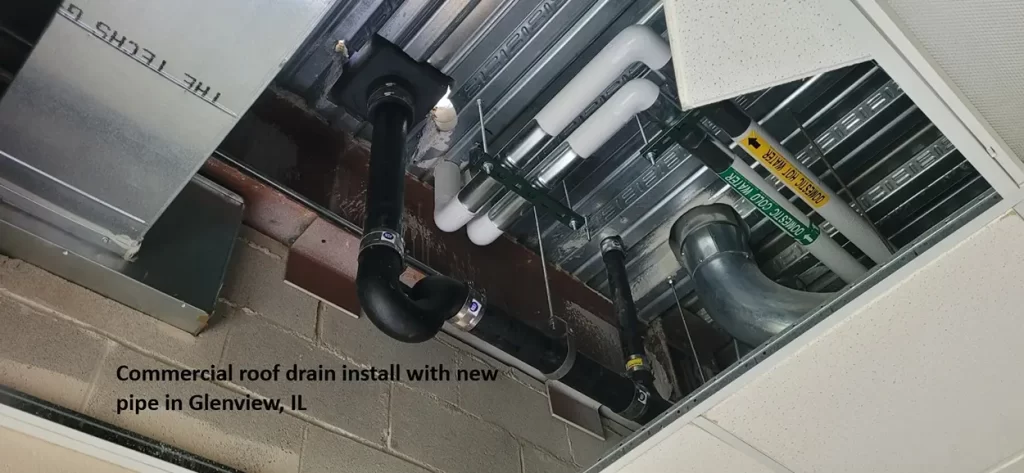
    Most calls start as cleanings. We clear the strainer, jet the drain body and the horizontal to the vertical stack, camera to confirm the run is clear, and reset a proper dome strainer. When the drain itself has failed we replace the drain body, re-flash the roof membrane in coordination with your roofer, and re-clamp. When cast iron risers below the drain have cracked, we cut back to sound pipe and re-pipe in cast iron or code-approved schedule 40, depending on the application.

    Overflow Scuppers and Secondary Drainage

    Illinois Plumbing Code requires secondary drainage on any flat roof where a primary drain failure would create a structural load. Overflow scuppers and secondary roof drains are your building’s second chance when the primary is clogged. We service, replace, and add secondary drainage on buildings that were built before code required it. It is cheap insurance against a roof collapse or a full interior flood.

    Talk to Us About Your Roof

    Call 847-234-9440 or use our contact form to schedule a roof drain inspection, a jet-cleaning, or a repair.