
Grease Trap Replacement, Service, and Compliance
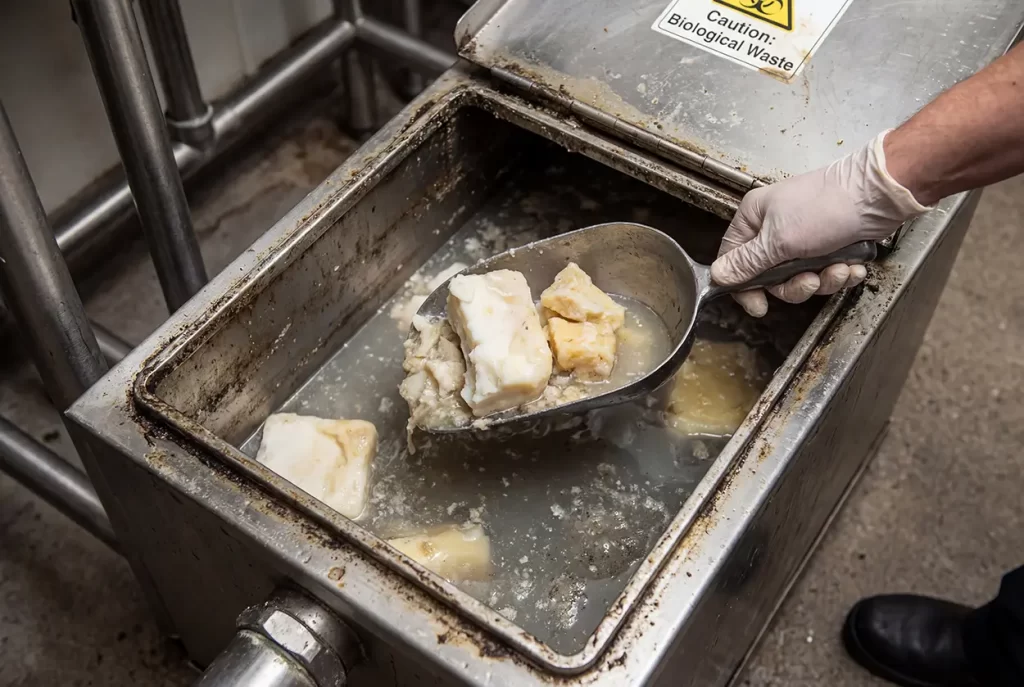
HT Strenger installs, replaces, and services commercial grease interceptors across Lake County and greater Chicagoland. Restaurants, cafeterias, bakeries, hotels, and any kitchen that runs a three-compartment sink or a wok line is required by the local sanitary district to keep fats, oils, and grease out of the public sewer. When your trap is undersized, cracked, or past its rebuild life, we scope the replacement, pull the plumbing permit, coordinate the pump-out, and install the new unit.
We start with an on-site inspection and a review of your last two years of pump-out tickets. If the tank still has service life, we say so.
IL Plumbing License #055-013973. Family-owned since 1911.
When a Grease Trap Needs to Be Replaced
Not every grease problem is a replacement. Sometimes it is a pump-out schedule that fell behind, or a partition baffle that needs to be reset. Real replacement candidates usually show one of these:
- Rusted-through steel tanks in older restaurants (typical 15 to 25 year service life).
- Cracked concrete or fiberglass tanks that are leaching odors or letting groundwater in.
- Traps that are undersized for the current kitchen. A grease interceptor sized for a 30-seat cafe will not keep up with the same footprint after it becomes a 90-seat family restaurant.
- Traps installed on the wrong side of a modernized dish machine or garbage disposal.
- Chronic grease discharge violations from the sanitary district despite a normal pump-out schedule.
Sizing and Local Code
Grease interceptor sizing is not guesswork. The Illinois Plumbing Code and most Lake County sanitary districts specify sizing based on drainage fixture units, sink volume, or gallons-per-minute flow through the connected fixtures. Under-sizing gets you a compliance letter within a year. Over-sizing costs you thousands of extra dollars and complicates the pump-out. We size to code and to your real operation, not to whatever tank the supply house had on the shelf.
Pro Tip: If you are remodeling a kitchen or converting a retail space into food service, price the grease interceptor into the project during design, not during buildout. Retrofitting a properly sized outdoor gravity interceptor after the slab is poured is roughly three times the cost of installing it up front.
Indoor Hydromechanical vs. Outdoor Gravity Interceptors
Smaller kitchens usually run a hydromechanical grease interceptor under the three-compartment sink, sized in gallons per minute (typical 20, 35, or 50 GPM units). Larger operations run an outdoor in-ground gravity interceptor sized in total capacity (1,000 to 2,000 gallons is common). Each has its trade-offs on cost, pump-out frequency, and available space. We help you choose the right style for your kitchen, then handle the permit and install.
Service, Repair, and Pump-Out Coordination
Between replacements, we service what you have. That includes baffle repair, flow-control fitting service, lid and gasket replacement, high-pressure jetting of the inlet and outlet branches, and coordinating pump-outs with a licensed hauler on the cadence your district requires. We keep a service record so your health inspector or sanitary district inspector always has documentation ready.
Talk to Us About Your Kitchen
Whether you are opening a new location, dealing with a compliance letter, or planning ahead on a tank that is nearing end of life, HT Strenger can scope the work. Call 847-234-9440 or use our contact form to reach a licensed commercial plumber.